Rabdology
The 400-Year-Old Word for What We Do.
April 4, 2026
Welcome to the Rabdology blog, where we chart the jagged edge of scientific reasoning in frontier AI models. We welcome feedback at contact@rabdos.ai.
I. The Ellipse and the Book
In 1609, Johannes Kepler published Astronomia Nova and announced that Mars moves in an ellipse: he was right in theory. Tycho Brahe, his predecessor as Imperial Mathematician, had left him twenty years of the finest naked-eye observations ever recorded. What Kepler did not have was any way to do the computations.
Fitting an ellipse to observational data requires iterating through cycles of multiplication, division, and root extraction on numbers running to ten or more digits. Kepler did this by hand. The orbit of Mars alone consumed four years of multiplying, carrying, checking, and multiplying again. At that rate, completing the planetary tables would have taken multiple lifetimes. The bottleneck was not theory and not data: it was compute.
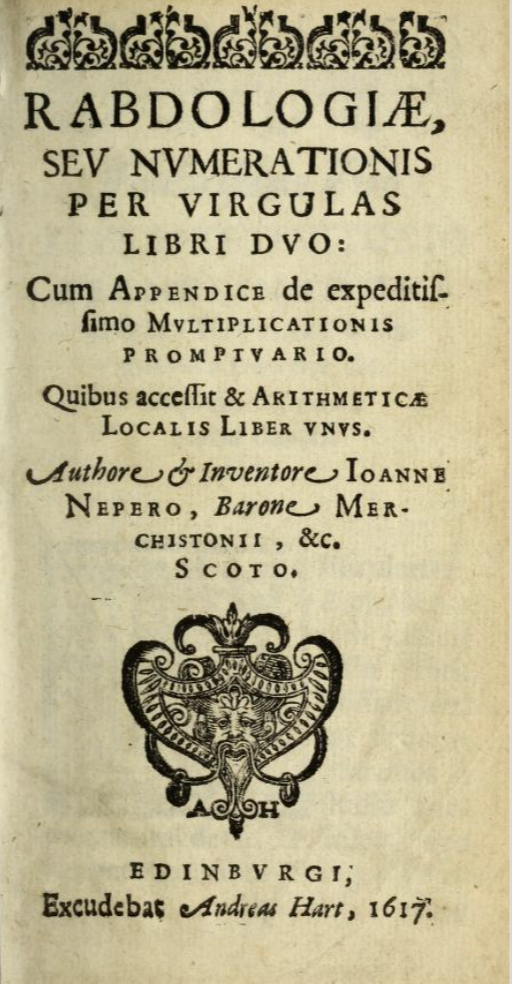
Eight years later and six hundred miles to the northwest, a dying Scottish baron published a small book in Edinburgh. One hundred and fifty-four pages, bound in vellum, four folding plates. John Napier, Baron of Merchiston — a laird and estate manager whose commentary on the Book of Revelation was better known in his lifetime than any of his mathematics, who enrolled at St Andrews at thirteen and left without a degree, who had recently published his logarithms, one of the supreme intellectual achievements of the early modern period. The base-10 tables he left to his friend Henry Briggs, a professor of geometry in London. His health would not permit the labor. This book was what he could still give. It was his last year.
On the facing page of the Rabdologiae, set between ornamental borders, an epigram:
Hoc parvo invenies esse remota libro.
you will find removed by this little book.
In the dedication, addressed to Alexander Seton, Chancellor of Scotland, Napier names the enemy precisely: the difficultatem & prolixitatem calculi — the difficulty and long-windedness of calculation — which deters many from the study of mathematics. He has spent his life, semper pro viribus, & ingenii modulo — always according to his strength and the measure of his talent — trying to remove that obstacle. His little book contains three inventions for mechanical calculation: rods for multiplication, a promptuarium for multi-digit products, and a method of local arithmetic performed on a chessboard. Three devices, each stranger than the last, published in ascending order of abstraction, each embodying a deeper idea about what it means to compute.
Kepler did not learn of Napier’s work until around 1619, two years after Napier had died. He dedicated his next book to the dead man anyway. With the aid of logarithmic tables — and later, tables of his own construction — Kepler completed the Rudolphine Tables in 1627, the most accurate planetary tables the world had seen, accurate not for months but for decades, and the work that ultimately established the truth of heliocentric astronomy. The computational tooling made the science possible.
We named our company after Napier’s rod — rabdos (from the Greek ῥάβδος) — the surveyor’s instrument that made earth-measurement possible. We named this blog after his book, because it contains all three levels of mechanical thought — lookup, prompted arrangement, and positional reasoning — and because knowing where each level lies is the territory we survey.
II. The Rods
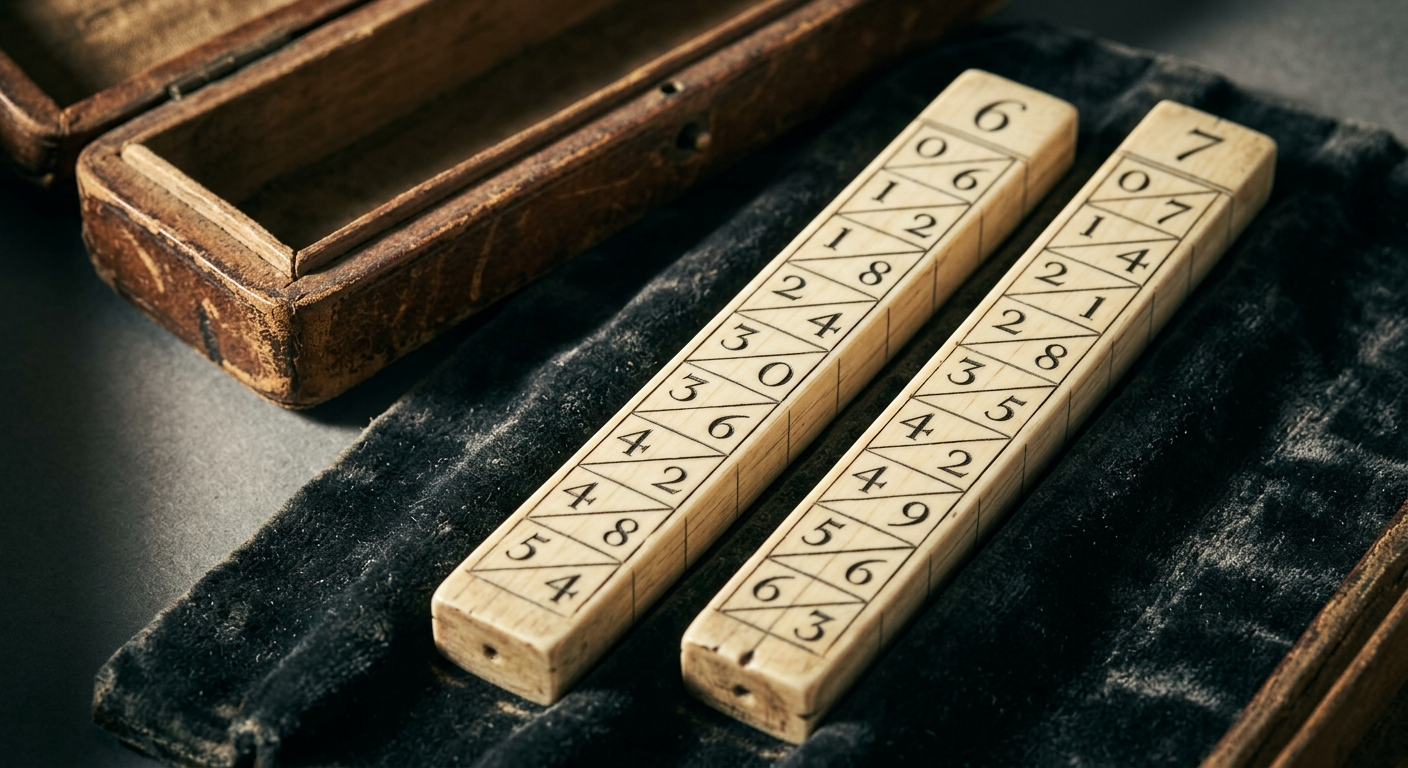
A single rod, four-sided, each face inscribed with the multiples of a digit from 1 through 9. The cells are bisected by diagonal lines, separating tens from units, so that when rods are placed side by side the diagonals form parallelograms whose contents can be summed to propagate carries. This diagonal is the entire mechanism. It is what makes the rods more than a printed multiplication table: it turns reading into computing, because the spatial arrangement of the diagonals does the carrying that a human calculator would otherwise have to perform.
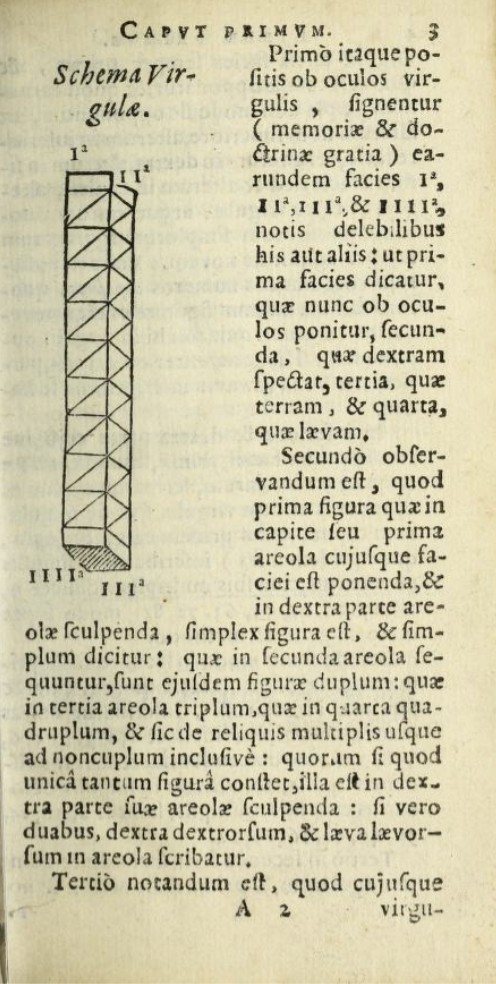
The procedure is best shown by example, and Napier chose a charming one: 1615, the annus Domini, multiplied by 365, the days in a year. Select rods whose top faces read 1, 6, 1, and 5, and set them side by side. The nine rows below now display every multiple of 1615 from twice to nine times, with the tens and units of each partial product separated by the diagonal. To multiply by 365, read the third, sixth, and fifth rows of the rod arrangement, sum the parallelogram diagonals from right to left, carry as needed, and combine the partial results with appropriate shifts. The product is 589,475. The reader need not take this on faith; the procedure is fully mechanical, and anyone with the rods in hand can verify it in a few minutes.
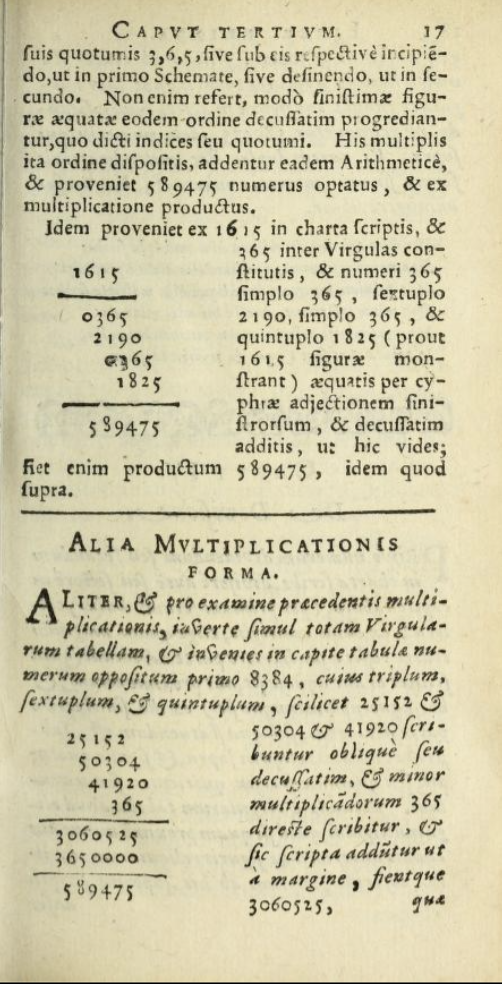
Within a generation, sets of Napier’s boneshad spread across Europe and as far as China and Japan. They were the most successful of his three inventions, and the simplest — which is, of course, why they succeeded. Napier’s explicit goal was to make mathematical understanding unnecessary for mathematical calculation. The rods encode knowledge onto a physical surface, and the user retrieves that knowledge through a spatial procedure that requires no grasp of why the procedure works: the algorithm works autonomously.
Four centuries later, a language model that has absorbed its training data has internalized multiplication tables of extraordinary scope — syntactic patterns, reasoning templates, solution structures seen millions of times in billions of documents. When it encounters a familiar problem, it reads off the answer the way a clerk reads off a rod: fast, confident, correct within the domain of the table. But the rod is a finite object.
III. The Promptuary
The title promised a second invention: Cum Appendice de Expeditissimo Multiplicationis Promptuario — with an appendix on a most expeditious promptuary of multiplication. Napier called it omnium ultimo a nobis inventum — the last of all our inventions — and placed it in the appendix not because it was minor but because it was newest. He considered it superior to the rods. History disagreed, but history was not paying close attention.
Promptuarium: in Latin, a storehouse, a place from which things are readily produced. The English word “prompt” descends from this root. To prompt is to produce readily from a prepared store.
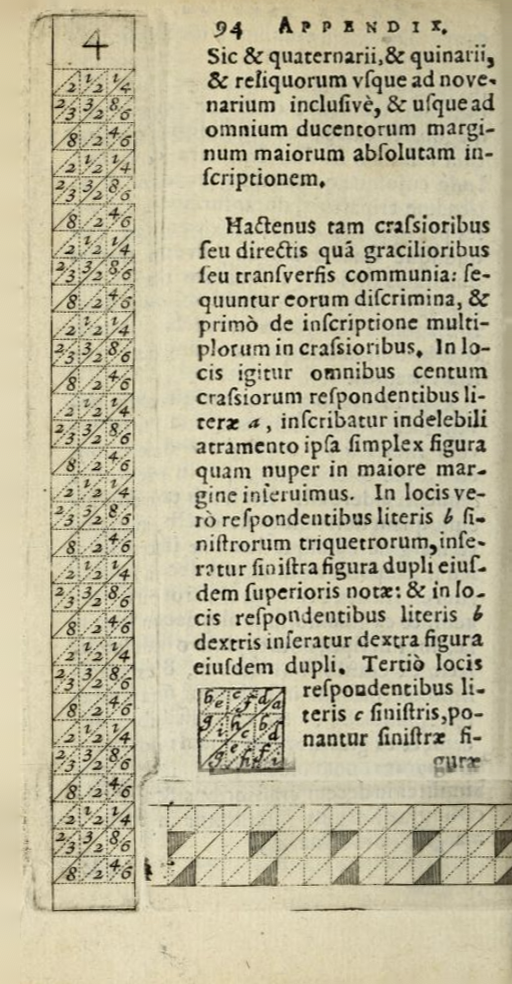
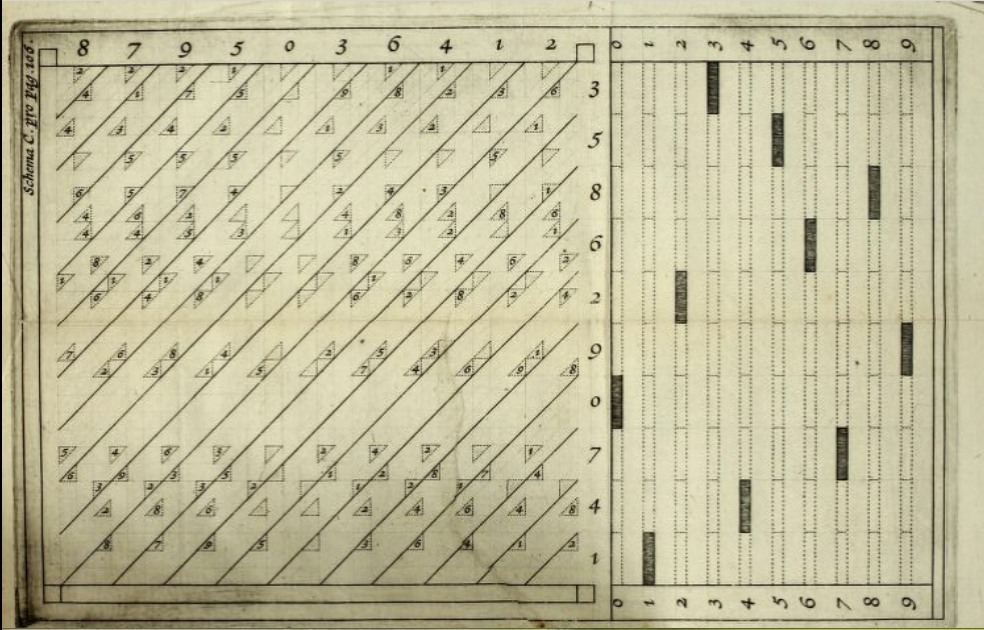
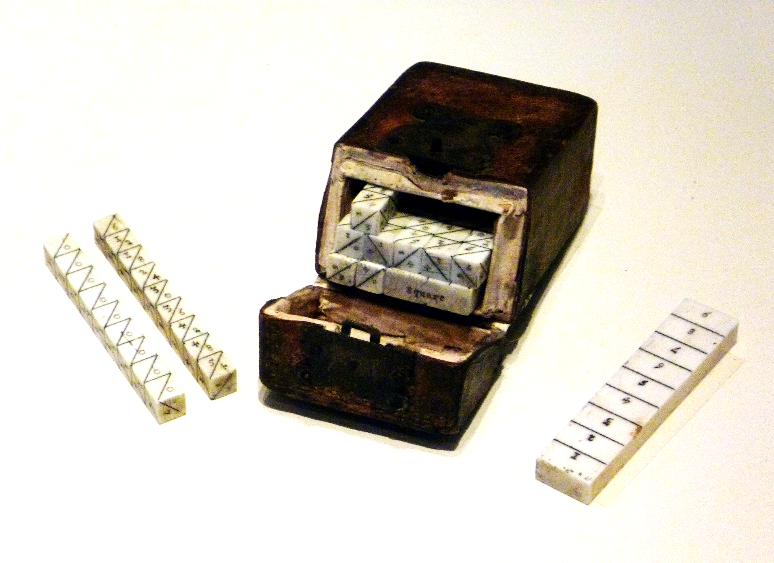
The Promptuary consists of two hundred strips, housed in a purpose-built box. One hundred are “direct” strips — thick, inscribed with multiplication tables in diagonal cells, like miniature versions of the rods. The other hundred are “transverse” strips — thin, perforated with triangular windows cut into them at precisely calculated positions. To multiply two numbers, you place the direct strips vertically on the lid of the box, one strip for each digit of the multiplicand, and lay the transverse strips horizontally across them, one for each digit of the multiplier. Where a triangular window in the transverse strip overlays a digit in the direct strip, the partial product becomes visible through the opening. The rest is concealed. You read the diagonals exactly as with the rods, sum the carries, and the product appears.
The architecture of the device is what matters here. With the rods, each digit of the multiplier required a separate lookup and a separate manual addition; the user performed multiplication as a sequence of retrievals, stitched together by hand. The promptuary performs multi-digit multiplication in a single spatial operation. The overlay itself does the selecting — the perforated windows expose exactly the right partial products and hide everything else, so that the structure of the arrangement carries computational weight that the rods delegate to the user. More strips, more cleverly organized, with the geometry of their interaction doing work that was formerly mental labor.
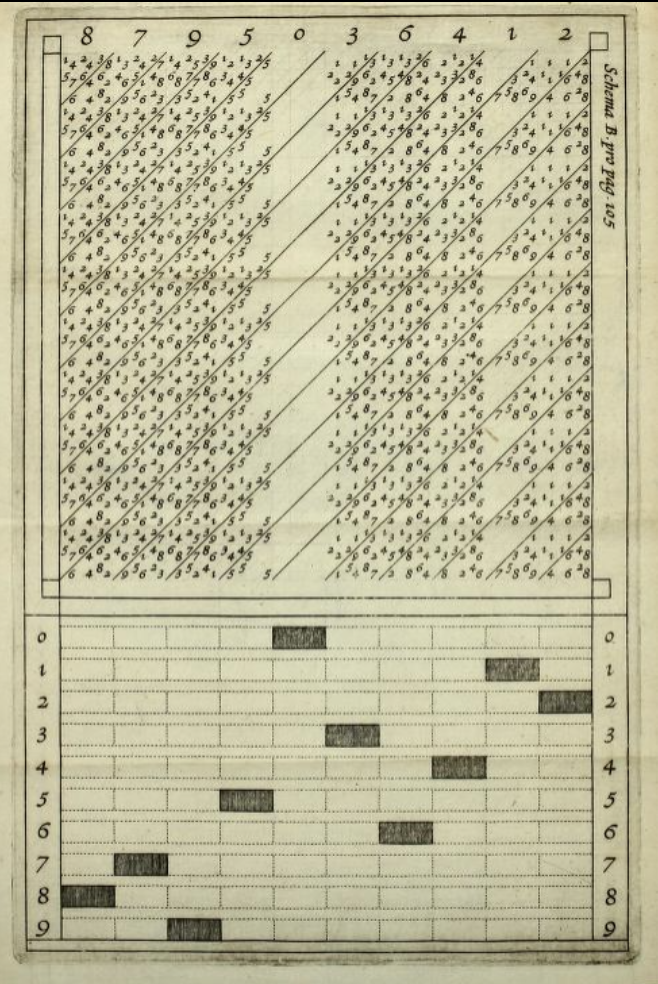
The illustrations in the Rabdologiae are extraordinary. Napier demonstrates a twenty-digit product from two ten-digit inputs — 8,795,036,412 multiplied by 3,586,290,741 — with every cell inscribed, every diagonal readable, the full answer laid out mechanically on a single plate. In 1617, with strips of ivory in a wooden box, he could multiply any pair of ten-digit numbers, reading the result from the diagonals without performing a single arithmetic operation beyond summing single digits.
This device’s fate was the opposite of the rods’. The promptuary was complex to build — two hundred precisely inscribed strips, a custom box with storage compartments for each — and only one early physical specimen is known to survive, in a museum in Madrid. The rods were simple and proliferated across continents; the promptuary was elegant and vanished. Napier’s finest invention was too intricate for the world that needed it.
Now the etymology earns its keep.
A language model is indeed a system for producing answers readily from a prepared store, where the arrangement of the query determines which stored knowledge becomes visible. What the prompt contributes is not new knowledge but a new arrangement — a pattern of windows that makes the right answers visible and hides the rest. The architecture is vastly more elaborate than Napier’s two hundred strips of ivory. The underlying principle is identical.
Napier thought his promptuary was his greatest invention. It was forgotten within a generation. AI winters began before the twentieth century.
IV. The Board
The title’s final clause is: Quibus accessit & Arithmeticae Localis Liber Unus — to which is added one book on local arithmetic. Accessit — it was added (pun intended?). The most radical content, placed last.
Napier had developed a method of performing all arithmetic — multiplication, division, extraction of square and cube roots — on a flat surface, a chessboard, by moving counters from square to square. He likened it to a game rather than work. The word localis is precise and essential: the computation is local, meaning that it depends on location. The value of a counter is determined entirely by where it sits on the board. The counters themselves are identical, unmarked, interchangeable. All the information is positional.
Along the margins of the board, Napier labels each position with a letter — a through q, then onward into the Greek alphabet — and with its corresponding power of 2: 1, 2, 4, 8, 16, 32, 64, 128, 256, 512, 1024, and so on. To represent a number, you place counters on the positions whose powers of 2 sum to that number. His example: 1611 becomes counters at positions l, k, g, d, b, and a — that is, at 1024, 512, 64, 8, 2, and 1. The sum is 1611. This is binary representation, described and operationalized three and a half centuries before it became the foundation of digital computing.
The conversion is algorithmic. Napier describes converting ordinary numbers to location numbers by repeated division by 2: if the number is odd, place a counter and subtract 1; divide by 2; repeat until nothing remains. This is the standard algorithm for binary conversion, taught today in every introductory computer science course.
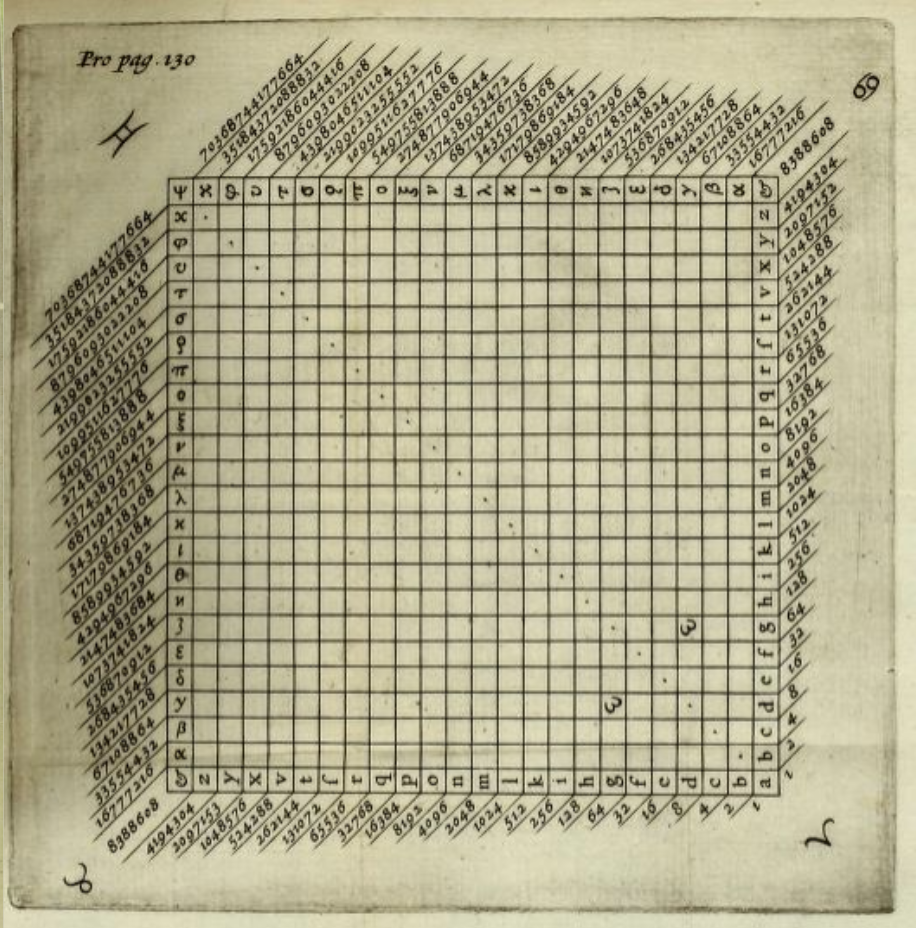
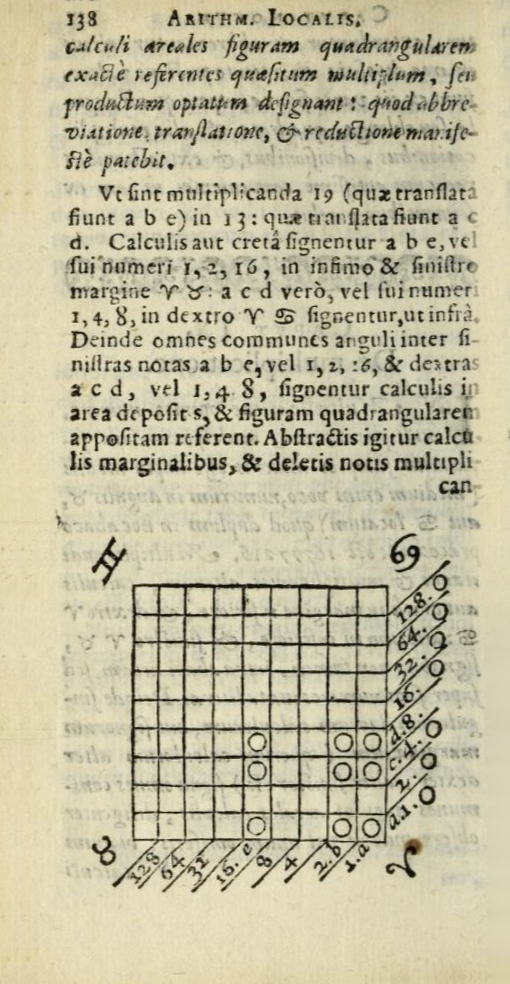
Multiplication on the board uses two margins, distinguished by astrological symbols. To multiply 19 by 13: represent 19 in binary along one margin (counters at positions a, b, and e, for values 1, 2, and 16) and 13 along the other (counters at a, c, and d, for 1, 4, and 8). Place a counter at every intersection of an occupied row and an occupied column. The board now holds the partial products as a constellation of counters scattered across the grid. Then abbreviate— Napier’s term for the carry propagation that reduces the board to canonical form. Wherever two counters occupy the same power-of-2 position, remove both and place one counter at the next higher position. When no further abbreviation is possible, read the result from the margin. The product is 247.
The procedure is binary multiplication implemented as a physical process on a grid. The counters are bits. The board is a register. The abbreviation rules are carry logic. Napier does not use any of these words, because none of them exist yet.
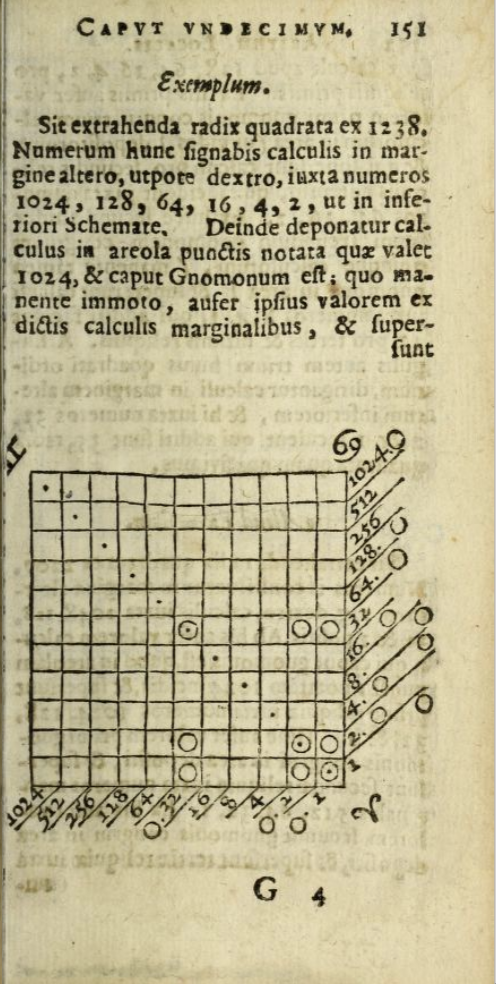
The tour de force is the extraction of square roots. Napier demonstrates finding the square root of 1238 on the board — placing counters for the binary representation of 1238 along one margin, then constructing square configurations of counters on the grid, subtracting their values through gnomon-shaped patterns (L-shaped configurations that represent the difference between successive perfect squares), and iterating until the board is exhausted. The result: 35, which is correct to the integer part. The actual value is 35.1852..., and Napier’s method can be extended to arbitrary precision by enlarging the board. He performs iterative numerical approximation using binary arithmetic on a chessboard, with counters and gnomons, in 1617. The diagrams — grids scattered with counters, L-shaped subtractions stepping across the squares — are among the most remarkable pages in the history of computation.
What makes the board different from the rods and the promptuary is not merely that it is more powerful. It is a different kind of thing. The rods encode specific facts: the multiplication table for 7 is inscribed on the surface of the rod for 7. The promptuary arranges encoded facts through the architecture of overlay, using perforations to select which pre-inscribed knowledge becomes visible. The board encodes nothing. The counters carry no inscriptions. There are no pre-computed tables, no diagonal cells, no perforated windows. The computational power resides entirely in the structure of the representation — binary positional notation — and in the rules for manipulating positions within that structure. The answers emerge from the geometry of placement: a type of analysis situs.
V. The Taxonomy of Mechanical Thought
Four centuries later, the taxonomy Napier never named is still the right one. Each of his three devices embodies a different relationship between mechanism and mathematical knowledge, and each fails in a different way when it reaches the boundary of what its architecture can represent.
The failures we have been documenting in this blog — models that reject their own correct answers, import unstated constraints, or lose the thread between local and global structure — are failures of the first two levels. They are the sound the table makes when you reach its edge, the gaps between the strips.
More training data is a longer rod. More elaborate prompting is a finer promptuary. Neither addresses the failures we see at the frontier, because those failures are not about the content of the tables but about the kind of reasoning the tables enable.
What Napier built on his board in 1617 — binary positional arithmetic, with carry logic and iterative approximation — is arguably the substrate of all modern computation. He saw that the most powerful representation was not the inscribed table or the structured overlay but the bare positional grid where identical tokens derive their meaning from location alone. He put it at the back of the book. The world adopted the rods.
It took three-and-a-half centuries for the board to become the foundation of everything.
VI. The Name
Rabdos: the Greek word for a rod. The surveyor’s instrument that made geometry — geometria, earth-measurement — possible. The tool you plant in the ground to triangulate the shape of terrain too large to see all at once.
Rabdologia: rod-reckoning. Napier’s coinage for the system of calculation with rods. Rabdos and logos — the rod and the word, the instrument and the reason.
In 1667, an English surveyor named William Leybourn published a guide under a magnificent title: The Art of Numbering by Speaking Rods: Vulgarly Termed Napier’s Bones — performed with incredible celerity and exactness (without any charge to the memory). Leybourn chose the wrong sense of logos— speech rather than reckoning — and “speaking rods” gave the devices their lasting English name. But Leybourn’s error may be less misstep and more prophecy. The central wager of the large language model is that the two senses of logos are not merely conflated but isomorphic — that if you model language deeply enough, reasoning emerges from the model naturally. Rods that speak; rods that reckon.
We named our company after the rod because the rod is where mechanical thought begins and extends to the magic wand that is AI. We named our blog after the book because the book contains all three levels — and because knowing where each level fails is the first step toward finding the next one. We are cartographers: we plant the rod and measure. The terrain is the landscape of AI mathematical reasoning, and the frontier is the jagged boundary where reckoning halts — where the rods run out of table and the promptuary runs out of strips. That moving, rushing boundary, propagating like a wave.
Napier opened his little book with a promise: Quae terrere solent ab amore Matheseos, illa / Hoc parvo invenies esse remota libro. What usually terrifies in the love of mathematics, you will find removed by this little book. Four centuries later, the models have inherited the ambition. They are succeeding — impressively — within the domain of the tables they have absorbed and the prompts they are given. The question now is not how to build better rods but whether someone, somewhere, is building the board. Napier placed his most radical invention at the back of the book, an afterthought, an accessit.
We are still looking for ours.